01Claim
What exactly is the claim?
Strip away the excitement, presentation and sales language. What result is actually being offered, to whom, and under what circumstances?

The poster shows you what could happen. The method helps you examine what would have to be true.
Six disciplined questions move you from the claim you are shown to a present position you can explain before money, time or trust moves.
Not an instant verdict. A better examination.

The questions are not six separate tests. They are one movement: from the claim in front of you toward a clearer present position.
Strip away the excitement, presentation and sales language. What result is actually being offered, to whom, and under what circumstances?
What can you actually see — documents, numbers, contracts, customer evidence, operating history or independent information?
A confident answer is not the same as a qualified answer.
How many people did not get the advertised result? What does an ordinary result look like? What costs appear later? What happens if you want to leave?
A missing answer does not automatically mean something is wrong. It means you still have something worth finding out.
The price on the page may be only one part of the commitment. The real cost is the commitment required to reach the result.
Customers may have to arrive. Sales may have to happen. A supplier or platform may need to perform. You may need to recruit, learn, advertise, drive, manage, sell, service or follow up.
Success can create its own costs, workload and dependencies. If the opportunity works as hoped, what happens next?
Once the picture is clearer, the question changes from “Do I like this?” to:
Knowing what I know now, what is the most sensible next move?
The method does not punish uncertainty. It makes uncertainty visible.
The number on the poster is not always the number that matters.
Claim to Cash is not designed to make the number look worse. It is designed to make the number more useful for a decision.

Sometimes the better question is not “Is this legitimate?” It is “Does this make sense for me?”
A genuine business can still require more money than you can safely risk. A genuine franchise can still be wrong for your location. A real course can still require skills or advertising money you do not have. A legitimate gig opportunity can still produce poor economics once vehicle costs and unpaid time are included.
Legitimate does not automatically mean suitable.
That is why the method also examines your available money, your time, your skills, your obligations, your ability to absorb a loss, how easily you can reverse the decision, and what happens if the expected result takes longer than promised.
The opportunity matters. So do you.
Success is not a reason to reject an opportunity. It is another condition worth understanding.
This is not a seventh framework question. It deepens Question 5: What has to go right?
The category changes. The discipline remains the same: examine what sits between the poster and your pocket.
The opportunity appears sufficiently understood, the downside is tolerable, and you know what you are committing to.
A document arrives. A claim is verified. A price changes. A trial succeeds. A contract is amended. A particular risk is limited.
Sometimes “I need more information before I move” is the most intelligent decision available.
The point is not to force certainty. The point is to make the next move explainable.
Before you commit, you usually have more choices than you will afterward. You can ask another question, request a document, run a smaller test, negotiate a condition, wait or walk away. A careful decision does not manufacture certainty. It helps you keep useful choices open long enough to decide.
We help you examine. You remain the decision-maker.
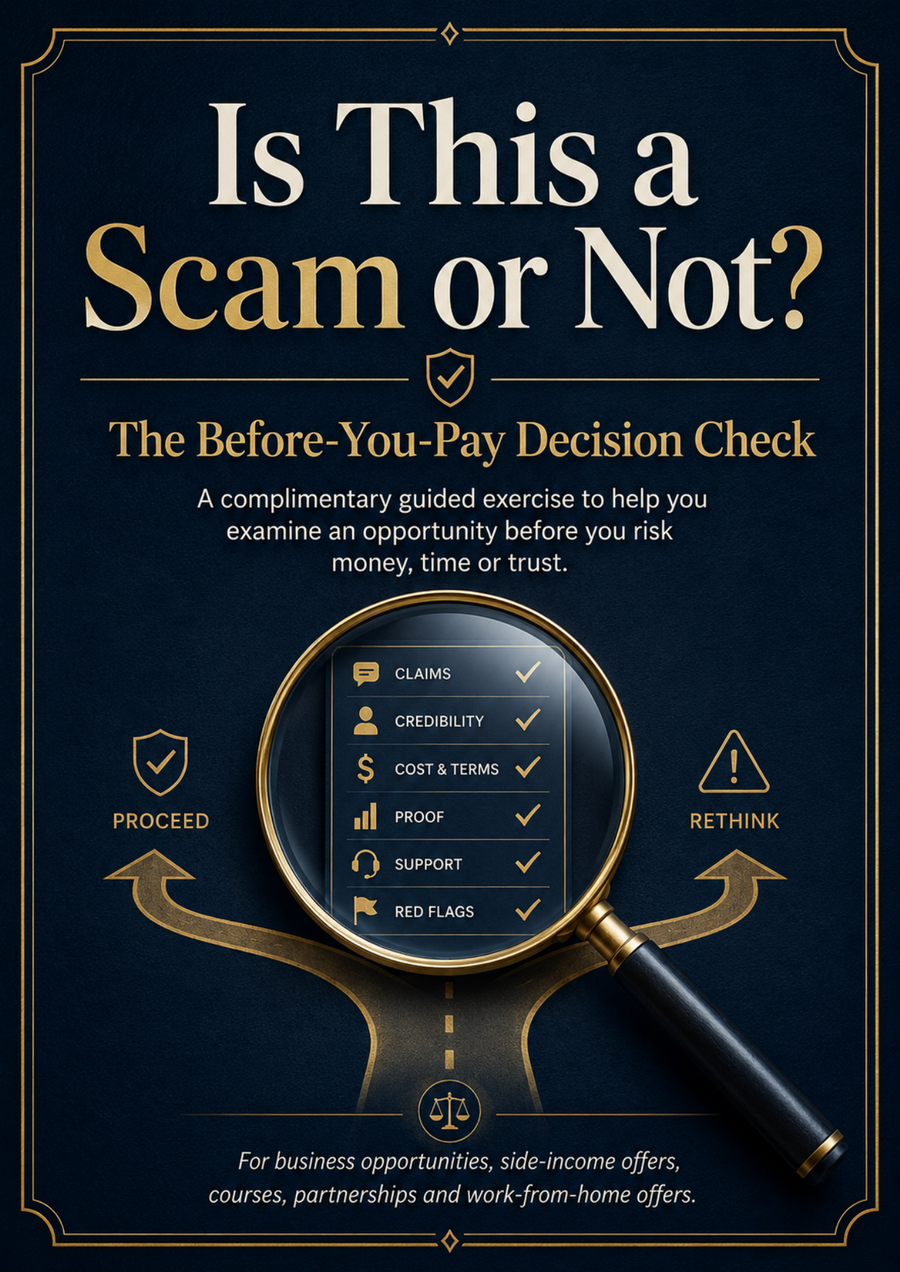
The Complimentary Digital Decision Check gives you a practical place to begin.
Still hopeful. No longer naïve.
No instant verdict. No pressure. The decision remains yours.